

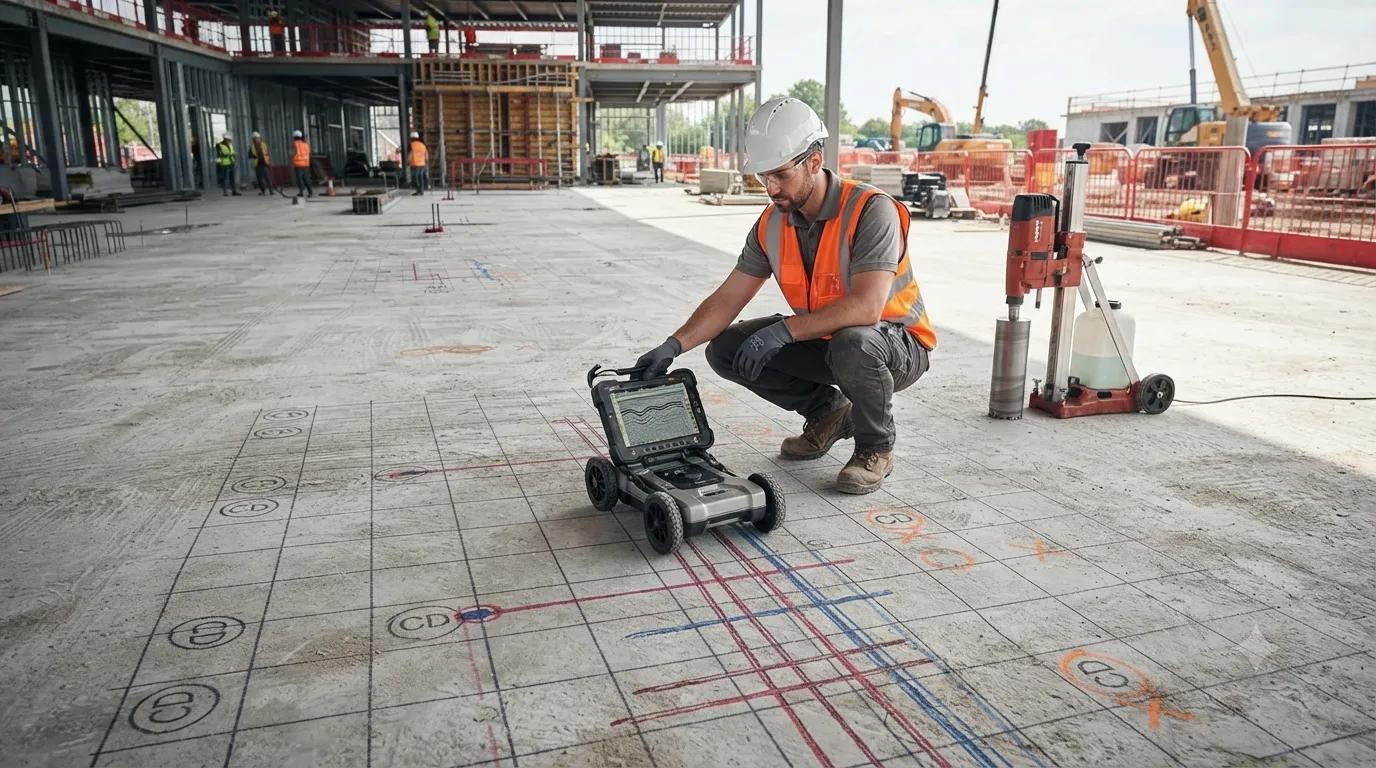
technician wearing full PPE performing
A coordinator books concrete coring services for Tuesday morning, only to realize scanning wasn't factored into the timeline until Monday afternoon. Now the whole sequence is at risk of slipping. Concrete scanning GPR works best when it's built into the schedule from the start, not squeezed in at the last minute. According to the American Concrete Institute (2023), close to 30% of concrete drilling incidents involve unmarked utilities or reinforcement damage, often because scanning was rushed or scheduled too late to catch issues properly. This guide covers what concrete scanning GPR involves, why timing it right matters for coring services, how the scheduling sequence should work, what it costs, and where a pull out test fits into the plan.
What Is Concrete Scanning GPR?
Concrete scanning GPR uses ground-penetrating radar (GPR), a device that sends electromagnetic pulses into concrete and reads the signal that bounces back. Rebar, post-tension cables, conduits, and voids each reflect radar differently than solid concrete, letting a trained technician map hazards without breaking into the surface first.
A technician moves the GPR unit across the slab in a systematic grid pattern. When it passes over a hazard, the display shows a distinct signal, and the technician marks that spot directly on the concrete with paint or chalk. This gives every crew involved in concrete coring services a clear, physical reference before any tool touches the surface.
GPR requires no radiation and no evacuation zone, unlike X-ray-based detection, which is part of why it fits easily into a tight commercial schedule. Most standard slab sections scan in under an hour, with results ready the same day.
What concrete scanning GPR typically identifies:
Rebar — steel reinforcement bars embedded for structural strength
Post-tension cables — high-tension cables carrying major structural load
Conduits and electrical lines — power and data cabling inside the slab
Voids — hollow or weak sections that could affect structural integrity

Why Does Timing Matter for Concrete Coring Services?
Scheduling concrete scanning GPR too close to a coring date leaves no room to react if a hazard is found. If a scan turns up a conduit running through a planned drill line, the coordinator needs time to adjust the drill point, notify affected trades, and possibly re-sequence other work — none of which happens smoothly under time pressure.
On one commercial project, a coordinator built the GPR scan into the schedule three days ahead of the coring date instead of the day before. That buffer turned out to matter: the scan found a cable running directly through a planned anchor line that wasn't shown on the drawings, and the extra lead time allowed the anchor layout to be revised without delaying the crew booked for concrete coring services. Had the scan happened the day before, that adjustment would have caused a same-day delay instead.
Reasons to schedule scanning with a buffer before coring:
Time to react — hazards found in the scan can be addressed without rushing
Fewer same-day delays — adjustments happen before the coring crew arrives
Better trade coordination — other trades can be notified of any changes early
Stronger documentation — reports are reviewed calmly, not skimmed under pressure
How Should the Scanning-to-Coring Sequence Work?
The process should start with a site walk scheduled early enough to inform final drill locations, ideally several days before coring services are booked. From there, the GPR unit passes over the marked area in overlapping rows to build a complete picture of what's below the surface.
A well-sequenced schedule looks like this:
Site walk (days ahead) — confirm coring zones and flag known hazards
Grid scanning — GPR unit passes over the slab in overlapping rows
Live signal reading — technician interprets rebar, cable, and void patterns
Report and review — coordinator reviews findings with enough lead time to adjust
On-site marking — safe-to-core zones are chalked directly on the concrete
Coring day — concrete coring services proceed within confirmed, marked zones
Post-drill testing — a pull out test confirms anchor strength where required
Once coring and anchor installation are complete, a pull out test applies controlled tension to a drilled anchor to confirm it holds its rated load without pulling loose. Scheduling this test as part of the same overall plan, rather than an afterthought, keeps the full sequence — scan, core, test — moving on a predictable timeline.

What Does GPR Concrete Scanning Cost, and How Does Timing Affect It?
GPR concrete scanning cost depends on slab size, site access, and scanned area, typically running as a flat fee for smaller jobs or a per-square-foot rate for larger commercial floors. Rushed scheduling can sometimes increase cost too, since last-minute requests may require pulling a technician from another job or paying an expedited rate.
Booking scanning with adequate lead time often avoids that premium altogether, since the provider can plan the technician's schedule normally. For coordinators, requesting GPR concrete scanning cost estimates alongside pull out test pricing at the same time coring services are booked keeps the full budget predictable from the start.
What Mistakes Do Coordinators Make With Scheduling?
The most common mistake is treating the GPR scan as something that can happen the day before or the morning of coring, leaving no time to react to findings. This turns what should be a routine step into a last-minute scramble if anything unexpected shows up.
Other frequent issues include booking concrete coring services before confirming the scan is even scheduled, assuming a scan from an earlier project phase still applies after design changes, and skipping the pull out test because the coring went smoothly, not realizing it checks something the scan and coring process don't.
Tips for Scheduling Scanning and Coring Together
Build at least a few days of buffer between the GPR scan and the coring date, so any findings can be addressed calmly. Request scanning, coring, and pull out testing quotes together so scheduling and cost stay aligned from the start. Confirm the scan report is reviewed by the site lead before coring begins, not just filed away.
Keep every scan report and test result on file centrally, since they're useful for compliance, insurance, and any future renovation work on the same building.
Concrete Scanning and Testing Services Compared
Service | What It Checks | Ideal Timing | Best Used For |
|---|---|---|---|
GPR Scanning | Rebar, cables, voids | Several days before coring | Locating hazards with time to react |
Concrete Coring Services | N/A (the drilling itself) | After scan review | Cutting cores once zones are confirmed |
Pull Out Test | Anchor holding strength | After installation | Verifying anchor performance |
No Scan | Nothing | N/A | Not recommended for any job |

FAQ
Q1: What is concrete scanning GPR? Concrete scanning GPR uses ground-penetrating radar to detect rebar, cables, conduits, and voids inside a slab before drilling begins.
Q2: How far ahead of coring services should scanning be scheduled? Ideally several days ahead, giving enough time to review findings and adjust drill locations without delaying the coring crew.
Q3: How much does GPR concrete scanning cost? Cost depends on slab size and access, with smaller jobs priced as a flat fee and larger jobs often priced per square foot.
Q4: What is a pull out test? A pull out test applies controlled tension to a drilled anchor to confirm it holds its rated load without pulling loose from the concrete.
Q5: Does rushing the GPR scan increase the cost? It can. Last-minute scheduling sometimes requires expedited rates or pulling a technician from another job.
Q6: Should pull out testing be scheduled at the same time as coring services? Yes, planning it as part of the same schedule keeps the full sequence predictable rather than adding it as an afterthought.
Conclusion
Concrete scanning GPR works best as a planned step with breathing room, not a rushed formality squeezed in before coring services begin. Building in a few days of buffer between the scan and the coring date gives coordinators time to react to findings, adjust drill locations, and keep other trades informed. Pairing this with a pull out test and budgeting for GPR concrete scanning cost from the start keeps the whole sequence predictable. If you're scheduling an upcoming coring job, it's worth building the scan in early rather than treating it as a last-minute step.