

Concrete looks solid, but it is rarely just concrete. Inside a typical slab, wall, or column there may be steel reinforcing bars, electrical conduits, plumbing sleeves, and post-tension cables, all hidden from view. When a core drilling machine meets one of these without warning, the consequences can be serious.
Cutting through rebar can compromise structural capacity and ruin expensive diamond bits. Striking a live conduit creates an electrical hazard for the operator. Hitting a post-tension (PT) cable is the most dangerous case. These cables are held under very high tension, and cutting one can cause a sudden release of energy, structural damage, or injury.
Even when nobody is hurt, the costs add up: emergency repairs, work stoppages, re-drilling, and strained client relationships. Nearly all of these outcomes are preventable with one step taken before the first hole is drilled: ground-penetrating radar (GPR) scanning.
What Is GPR Concrete Scanning?
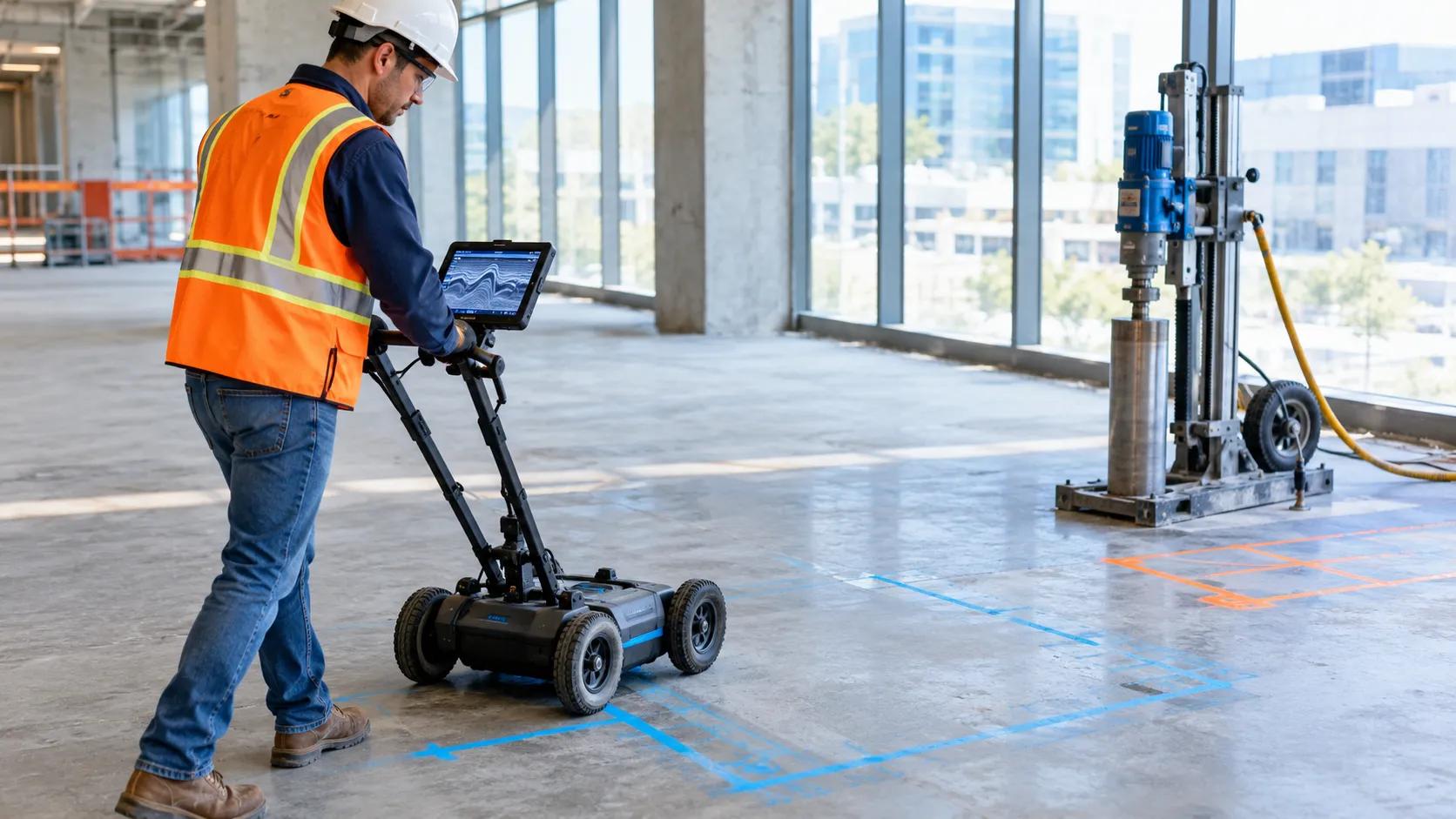
GPR is a non-destructive method for looking inside concrete without breaking it. A technician rolls a small antenna unit across the surface. The unit sends short pulses of radio-frequency energy into the concrete and records the signals that bounce back.
How It Works in Simple Terms
Radio waves travel through concrete until they meet something with different electrical properties, such as steel, plastic, air, or water. At that boundary, part of the signal reflects to the antenna. The equipment measures how long the reflection takes to return, which indicates how deep the object is.
As the antenna moves, these reflections build a cross-section image of the slab. A rebar typically appears as an arch-shaped curve on the screen, and a trained operator learns to read the size, spacing, and depth of these patterns. Results are shown in real time, and the operator can mark findings directly on the concrete surface.

What GPR Can Detect
Rebar and wire mesh: location, spacing, and approximate depth
Post-tension cables: often identified by their pattern, depth, and draping profile
Conduits and pipes: both metallic and non-metallic, though plastic can be harder to see
Voids and anomalies: air pockets, honeycombing, or gaps beneath a slab
Slab thickness: useful when drawings are missing or unreliable
GPR vs. Other Methods
GPR is not the only way to investigate concrete. Here is how it compares with two common alternatives.
GPR vs. X-Ray (Radiography)
Concrete X-ray can produce detailed images, but it uses ionizing radiation. That usually means cordoning off areas, evacuating nearby occupants, and working after hours. It also requires access to both sides of the element, and film or image processing takes time.
GPR needs access to only one side, produces no radiation hazard, and gives results on the spot. For most building projects, it is the faster and more practical option.
GPR vs. Manual Locating
Relying on as-built drawings, visual cues, or experience alone is the least reliable approach. Drawings may be outdated, and previous renovations or field changes often go undocumented. Guesswork cannot confirm what is actually inside the slab.
Factor | GPR | X-Ray | Manual / Drawings |
|---|---|---|---|
Safety | No radiation | Radiation exposure; area restrictions | Highest risk of unexpected strikes |
Speed | Real-time results | Slower; processing required | Fast, but unverified |
Accuracy | High for most conditions | High, with limited access | Low and unverifiable |
Access needed | One side | Both sides | None |
When Scanning Is Needed
A good rule is to scan any time you plan to penetrate, cut, or fasten into concrete. Common situations include:
Core drilling: Before using a concrete drilling machine to create openings for pipes, conduits, or ducts. Core drilling can range from small holes to large penetrations, and every one benefits from knowing what lies behind the surface.
Anchor installation: Drilling for anchors can hit reinforcement just as easily as coring. Scanning helps place each anchor where it can be installed safely.
Saw cutting: Wall saws and slab saws cut long lines through concrete, increasing the chance of intersecting hidden elements.
Structural assessments: GPR can help verify reinforcement layout, slab thickness, and potential voids as part of a broader evaluation.
Renovation and retrofit work: Older buildings often have undocumented changes, making scanning especially valuable.
Scanning also supports testing. If you install anchors that will later be verified through pull test anchors procedures, confirming a clear location beforehand helps avoid damage to reinforcement. Pull testing checks whether an installed anchor can carry its intended load, which matters most for safety-critical fixings such as fall-protection and lifeline anchors.

What to Expect During a Scan
The Process
Planning: The provider reviews the scope, access, and what needs to be located.
Surface preparation: The area should be reasonably clear and accessible. Smooth, dry surfaces give the best results.
Scanning: The technician moves the antenna in a grid or along set lines, and the data appears on screen in real time.
Marking: Detected items are marked on the surface, often with chalk or paint, so crews can see safe and unsafe zones.
Review: Findings are discussed on site, and any unclear readings can be rescanned or checked from another direction.
How Long It Takes
Most small to medium scanning tasks can be completed within hours, depending on the number of locations and site conditions. Larger floors or multi-level projects take longer. Because results are immediate, work can often proceed the same day.
What the Findings Report Includes
A professional report typically contains:
Locations scanned, with sketches or annotated photos
Depth and spacing of rebar, PT cables, and conduits where detected
Recommended safe locations for drilling or cutting
Notes on any limitations or areas where results were uncertain
Equipment used and the date of the scan
Limitations of GPR
GPR is powerful, but it is not magic. Understanding its limits helps you use it wisely.
Depth: Penetration depends on antenna frequency and material. Higher frequencies give sharper detail at shallow depths, while lower frequencies reach deeper with less resolution.
Dense reinforcement: Closely spaced or multi-layer rebar can shadow objects beneath it.
Moisture and salts: Very wet or chloride-contaminated concrete absorbs the signal and reduces clarity.
Surface conditions: Rough, uneven, or obstructed surfaces make it harder to keep good antenna contact.
Non-metallic items: Plastic conduits can produce weaker reflections than metal ones.
Interpretation: Results depend on operator experience. Two technicians can read the same data differently if one lacks training.
A reliable provider will explain these constraints up front and, where necessary, recommend a second method or a cautious approach, such as pilot holes or a more conservative drilling location.
For a technical baseline, ASTM International publishes standards on using GPR for subsurface investigation, available at ASTM International. The American Concrete Institute also offers guidance on concrete construction and evaluation practices.
Tips for Choosing a Qualified Scanning Provider
Not all concrete scanning services are equal. When evaluating a provider, consider:
Licensing and insurance: Confirm they are properly licensed and carry liability coverage. Ask for documentation.
Equipment: Modern, well-maintained GPR units and a core drilling machine suited to your project size indicate a serious operation.
Experience: Ask about similar projects, such as parking structures, healthcare facilities, government buildings, or historic sites.
Technician training: Data interpretation is a skill. Ask who will be on site and how they were trained.
Reporting: Look for clear, written documentation rather than verbal estimates alone.
Turnaround time: Check availability, including after-hours or weekend work if your schedule is tight.
Communication: A good provider answers questions plainly and explains limitations honestly.
Conclusion: A Small Step That Prevents Big Problems
Concrete hides what matters most: the reinforcement, cables, and utilities that keep a structure safe and functioning. GPR scanning shows what is inside before a core drilling machine or saw makes an irreversible cut. It is fast, radiation-free, and well suited to most building projects, and it costs far less than the repairs that follow a blind strike.
Key takeaway: Never drill, core, or cut into concrete without first confirming what is inside it. If your next project involves penetrating a slab or wall, contact a qualified scanning professional before work begins.